
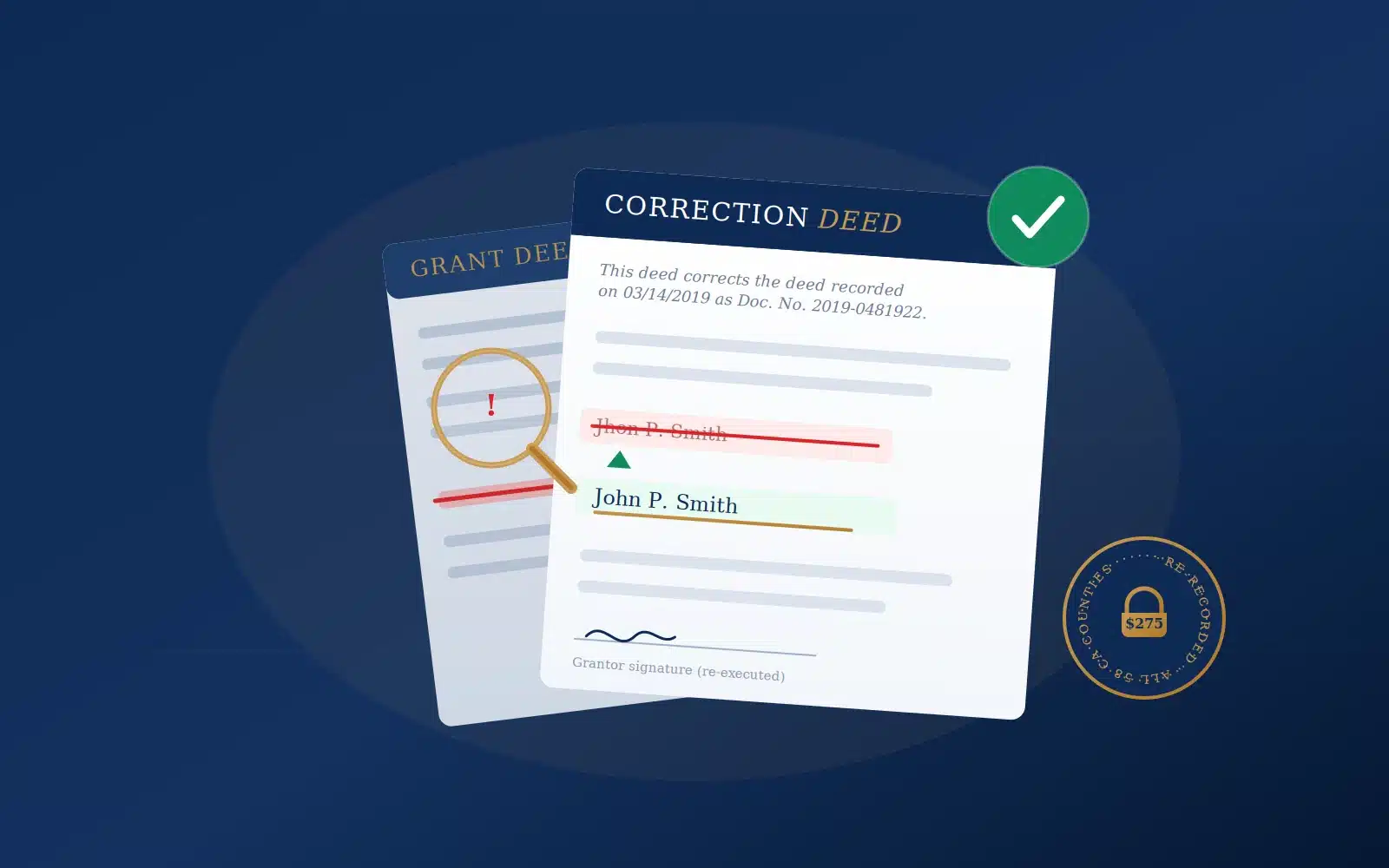
Correction Deed Nevada —
Fix a Deed Error, $300.
A misspelled name. A transposed lot number. A missing marital status. The deed recorded anyway, and nothing felt wrong — until a title company pulled the chain and the closing stopped. Our $300 prepares the correction deed and the Declaration of Value. Notarization, e-recording and the county’s own fee are separate lines, all published below.
How do I fix a mistake on a recorded deed in Nevada?
In Nevada you fix a clerical mistake on a recorded deed in one of two ways: by re-recording a certified copy of the original document with the corrections marked and a cover sheet attached, or by recording a new correction deed that references the original and restates it correctly. The Clark County Recorder accepts both. A re-recorded document must be signed and acknowledged again, and it gains one extra page.
The document must identify the original conveyance by the type of error, the date it was signed, the date it was recorded, and its recording number and location. It then restates the prior deed with the error fixed. The original deed stays on the record permanently — nothing is deleted. Both documents appear in every future title search, which is exactly why the correction has to be right.
Because a true correction does not transfer a present interest, the document is ordinarily recorded without Real Property Transfer Tax, under the exemption for a document recognizing the true status of ownership. If the document actually changes who owns the property, transfer tax may apply — that is a conveyance, not a correction. Either way a completed Declaration of Value accompanies it, the exemption is claimed on that form, and Clark County audits the claim at the counter.
TruPoint charges $300 to prepare the document and the Declaration. Notarization with our Clark County partner notary is $15 for the first signature and $7 for each additional signature by the same signer. Electronic recording is $50. The county recorder charges its own fee, between $37 and $43 depending on the county. A correction is submitted to the county the same day, with the recorder typically completing recording within one to three business days.
A second document that fixes the first one.
A correction deed — some title officers call it a corrective deed — is a new instrument that points back at the deed with the mistake and states the correct information. It changes nothing about who owns the property. It changes what the public record says about it.
- It names the original deed by recording number, date, and the specific error.
- It restates the original conveyance, corrected.
- It is signed by the original grantor and notarized like any other deed.
- It records with a completed Declaration of Value, like every Nevada deed.
The original deed is not erased. Both stay on the record, side by side, so a title examiner in ten years can see the mistake and see that it was cured.
Nobody reads their deed twice. Then something stops.
The title company found it
You listed the house, escrow opened, and the title search flagged a name that does not match your ID. The buyer’s lender will not fund until the record matches.
The lot number is wrong
Lot 15 was typed as Lot 51. The deed recorded. On paper you may hold title to a parcel you never bought, and not to the one you live in.
The trust never got funded properly
The deed moved the home into the trust but misnamed the trust, or omitted the date it was signed. The trust may not hold what you think it holds.
What a correction deed fixes — and what it cannot.
This is the part the form sites leave out, and it is the part that decides whether you have wasted $300 and a trip to the notary. It cures clerical error. It does not change a transaction.
What it can fix
- A misspelled or incomplete name — “Jon Smith” for “John Smith”
- An omitted or wrong marital status
- A typo in the legal description — a transposed lot, block, or subdivision name
- A wrong or missing assessor’s parcel number
- A wrong street address where the legal description is otherwise correct
- A misnamed trust, or a missing trust date, on a funding deed
What it cannot fix
- Adding an owner, or removing one — that is a new conveyance
- Changing which land was conveyed
- Changing the consideration, or the price paid
- Changing how title is held, when the parties disagree about the intent
- An error the original grantor will not sign to correct
- Fraud or forgery in the original deed
A second bad deed is worse than the first one.
A correction deed looks like a short document, which is exactly why people download a blank and try it. The form records. The problem shows up later, when a title examiner reads both documents together and cannot tell what was intended.
A blank cannot reference your deed
The correction has to name the original by its recording number, its date of execution, its date of recording, and the exact error. A downloaded template does not know any of those, and a correction that fails to identify what it corrects corrects nothing.
The recorder audits your exemption
Clark County examines the exemption claimed on the Declaration of Value at the counter and asks for supporting documentation. Claim the wrong one and the document is rejected, or transfer tax is assessed on a correction that never transferred anything.
Waiting turns a typo into a lawsuit
Correct it while the original grantor is alive, reachable, and willing to sign. Once a grantor dies, moves, or refuses, a clerical typo becomes a court action to reform the deed — with a complaint, service on every interested party, and a hearing.
Three steps, and the record tells the truth.

We pull the recorded deed
We read the original as the recorder holds it, find the error, and confirm a correction deed is the right instrument — not a new conveyance and not a court matter.
We prepare the correction
We draft the document referencing the original by recording number, date, and error, restate the deed correctly, complete the Declaration of Value, and provide signing instructions.
We record it for you
We e-record with the county and return your recorded copy — submitted to the county the same day; the recorder typically completes recording within one to three business days, in any Nevada county. No trip to the recorder’s counter.
A short list, and we take it from there.
- A copy of the recorded deed with the error — we can pull it if you don’t have it.
- What the deed should have said, and how you know.
- The original grantor’s willingness to sign the correction.
A Registered Document Preparer, not a form website.
Every correction deed is prepared by Quinnie Do, a registered and bonded Nevada Document Preparation Service. She reads the recorded original before she writes a word, because a correction that misnames the error is a correction that fixes nothing.
She prepares documents in Nevada under her Nevada registration, and in California under a separate California credential that carries no authority here. She is also an IRS-registered tax return preparer and an IRS Certifying Acceptance Agent for ITIN applications — useful when the owner on the deed holds a passport rather than a Social Security number. Nevada requires her name, address, phone, and registration number on every document she prepares.

Fixing the record is not moving the property.
The distinction the recorder cares about is simple. A correction says the original transfer was right and the paperwork was wrong. A new conveyance says the paperwork was right and the transfer needs to change.
Get that backwards and you either cloud your own title or pay transfer tax you never owed. If your deed named the wrong grantee entirely, or you now want a different owner on title, that is a conveyance — and it is a different page, a different document, and sometimes a different tax answer.
We will tell you which one you are looking at, and we will not prepare the wrong one because it is the one you asked for.

Know the price before we begin.
Deeds.com puts the national cost of a correction at $50 to $500 including recording. One Las Vegas firm publishes $542 for a first deed. We publish every line, including the ones that are not ours.
The tax that usually doesn’t apply — and the form that always does.
Nevada’s Real Property Transfer Tax is a one-time government charge collected by the county recorder when ownership changes hands for value. It is $2.55 per $500 of value in Clark County, $2.05 in Washoe and Churchill, and $1.95 across most of the state. It is never part of our fee.
A correction is not a transfer
Because a true correction conveys no present interest, it is ordinarily recorded under the exemption for a document recognizing the true status of ownership.
Exempt is not the same as unrecorded
An exempt document still records, still needs a completed Declaration of Value, and still pays the recorder’s fee. The exemption changes the tax, not the filing.
The exemption is claimed on the Declaration
Nevada has no separate exclusion form. The claim is made on the Declaration of Value itself, and the Clark County Recorder audits it when the document is presented.
Other exemptions people ask about
Transfers between spouses or by divorce decree; parent to child; into or out of a trust without consideration with a certificate of trust; a deed upon death; and entity transfers where beneficial ownership does not change.
Change the ownership and the tax may apply
If the document does more than fix a clerical error — if it moves an interest to someone new — it is a conveyance, and the Real Property Transfer Tax may apply at the county’s rate. Calling it a correction does not make it one.

Check us with the state before you pay a dollar.
The Clark County Recorder posts a Nevada Attorney General consumer-protection alert on its own front page about companies charging for copies of recorded documents. Be suspicious of everyone, including us. Nevada publishes its registry of document preparation services, and the recorder publishes exactly how a correction must be filed. Read both.
Nevada Secretary of State
The document preparation service program: who must register, what the state requires, and how to file a complaint.
nvsos.gov ↗Clark County Recorder
The official page on re-recording a document to make corrections, straight from the recorder’s office.
clarkcountynv.gov ↗Recording in Clark County
Recorder fees, the Declaration of Value, and how a correction is e-recorded for you.
Clark County →If a correction is not what you need.
Every Nevada deed we prepare
The hub: transfers, quitclaims, deeds upon death, trust funding, and entity deeds.
Deeds & Title Transfers →Grant, bargain and sale deed
Nevada’s standard conveyance — the instrument when the fix is a new transfer, not a correction.
Grant, Bargain & Sale →Affidavit of death of joint tenant
Clear a deceased co-owner’s name from title, without probate.
Affidavit of Death →Record a deed in Clark County
Recorder fees, the Declaration of Value, and how a correction is e-recorded for you.
Clark County →Who prepares your correction
Quinnie Do, a registered Nevada document preparer whose name goes on the document.
About TruPoint →Nevada document preparation
Deeds, living trusts, lender documents and name changes, statewide.
Home →Fingerscan Digital — our sister service
Fingerprinting, apostille, and Live Scan are handled by Fingerscan Digital. It operates separately from TruPoint and answers a different phone number.
Deed corrections, answered plainly.
Two routes. You can re-record a certified copy of the original deed with the corrections marked and a cover sheet attached, which adds one page and requires the document to be signed and acknowledged again. Or you can record a new correction deed that references the original by recording number, date, and error, and restates it correctly. The Clark County Recorder accepts both. The original deed stays on the record either way.
A correction deed, sometimes called a corrective deed, is a document recorded with the county that fixes a clerical error in a previously recorded deed without changing ownership. It identifies the original deed by the type of error, the date of execution, the date of recording, and the recording number, then restates the original conveyance with the error corrected.
It matters at the moment you try to sell, refinance, or pass the property to your family. Title companies match the name on the deed against the name on your identification, and a lender will not fund against a chain of title that does not line up. The mistake sits quietly in the public record until money depends on it.
TruPoint charges $300 to prepare the correction deed and the Declaration of Value. Notarization with our Clark County partner notary is $15 for the first signature and $7 for each additional signature by the same signer. Electronic recording with the county is $50. The county recorder charges its own fee, between $37 and $43 depending on the county. If the document changes ownership, transfer tax is added on top.
For comparison, Deeds.com puts the national range at $50 to $500 including recording fees, and one Las Vegas firm publishes $542 for a first deed. We are not the cheapest, and we say so.
Ordinarily no. A true correction conveys no present interest, so it is normally recorded under the exemption for a document recognizing the true status of ownership. But if the document changes who owns the property, transfer tax may apply — that is a conveyance, not a correction, and the county charges $2.55 per $500 of value in Clark, $2.05 in Washoe and Churchill, and $1.95 across most of the state.
Either way a completed Declaration of Value accompanies the document, the exemption is claimed on that form, and the Clark County Recorder audits the claim when it is presented. Exempt from transfer tax is not exempt from recording.
No. It cures clerical error only. Adding an owner, removing an ex-spouse, or changing the land conveyed is a new conveyance — ordinarily a quitclaim deed or a grant, bargain and sale deed. Using this document to do it can cloud your title instead of clearing it, and we will not prepare one for that purpose.
Generally the original grantor — the person who signed the deed with the mistake — signs the correction, and the signature is notarized like any other Nevada deed. Where the correction changes how the grantees hold title, the grantees may need to sign as well. If the original grantor will not sign, this is no longer the answer.
Then the clerical route closes. Depending on the facts, the fix may run through the estate, or through a court action to reform the deed — a lawsuit asking a judge to rewrite the instrument to match what the parties intended. That is a matter for a Nevada attorney, and we will tell you so plainly rather than sell you a document that cannot work.
A scrivener’s affidavit is a sworn statement by the person who drafted the original deed, attesting to a drafting error they made. A correction deed is signed by the original grantor and can address a wider range of clerical problems. Which instrument a county recorder or a title company will accept depends on the error, so the recorded original gets read first.
No. Nothing is ever deleted from the county record. The original deed and the correction both remain, permanently, and both show up in every future title search. The correction explains what was wrong and what the truth is. That is the whole point: a title examiner years from now needs to see the error and see that it was cured.
Yes. We prepare and e-record in every Nevada county, including Washoe, Carson City, Douglas, Lyon and Nye. Clark County records documents on the spot; some rural recorders are slower to return proof. Recording speed is the recorder’s decision, so we describe what is typical — one to three business days — rather than promising a date.
Every Nevada county, recorded electronically.
Nevada has 16 counties plus Carson City — seventeen recording jurisdictions, and we e-record in all of them. You never visit a counter, and it does not matter where you live. The document records in the county where the property sits.
Fix the record before it costs you a closing.
Send us the recorded deed. We will tell you whether a correction deed is the right instrument, what the county will charge, and every line of our own fee — in English or Vietnamese, before you owe anything. Prefer to call? Reach us on (877) 221-8386. We record in all 17 Nevada counties.